The thesis examines how ideas of social reproduction interact with concepts of change in Emma Goldman’s (1869–1940) thinking, and how her use of Henrik Ibsen’s (1828–1906) plays as literary thought experiments visualize and develop her political theory.
About this project
This is a project that speaks to two different disciplines, on the one hand the history of ideas, and on the other feminist political theory, and more concretely social reproduction theory. The aims of this thesis are therefore twofold.
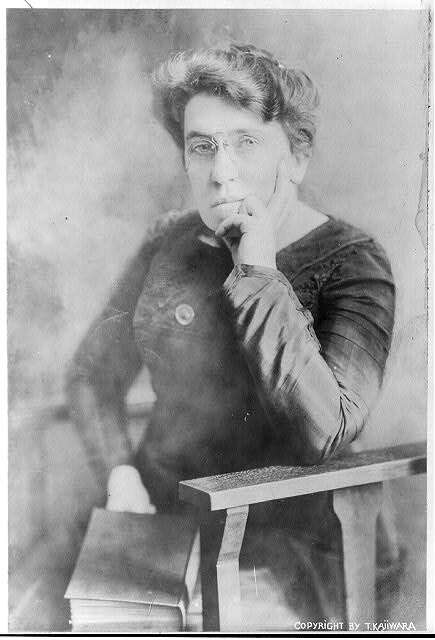
First, I intend to contribute to the history of the political debate on the New Woman that flourished in the United States and Europe into the 20th century. This will be done through studying the New Woman from the perspective of Ibsen’s plays, and through the thematization and questioning of how sexuality and motherhood can challenge the liberal idea of freedom.
Second, and more closely linked to Goldman’s texts, the goal is to reconstruct a theory of what has later been described as social reproduction theory. This will be done by focusing on Goldman’s use of drama, importantly, Ibsen’s dramatic works, to debate political and philosophical issues.
By meeting both aims, the thesis makes a contribution to the perspective of change for social reproduction theory today. It also contributes to a clearer understanding of the overlooked role of drama in bringing about social change in Goldman’s works.
The project covers material ranging from Goldman’s published and posthumous work to unpublished notes from 1893 through 1940. The material is contextualized and reconstructed to visualize her theory on social reproduction and change.
Objectives
The aims are approached through the following research questions: How did ideas of social reproduction intersect with ideas of change in Goldman’s thinking? How did Goldman’s use of Ibsen’s plays and literary figures as thought experiments enable her to visualize and develop her political theory? Goldman’s ideas of social reproduction, as they appear in her political writings when encountering Ibsen’s plays, will be reconstructed, analyzed, and presented through four central themes: drama, alienation, primitive accumulation, and the masses.
Contribution
The theory of emancipative reproduction entails Goldman’s response
Firstly, I show that Goldman developed a notion of the New Woman that differs from how her contemporaries embraced the phenomenon in arguments for women’s suffrage.
Secondly, I show that Goldman challenged the liberal idea of freedom advocated by the women’s movement of her time, and made use of drama to visualize an account of the state and capitalist social organization as structured around the ongoing exploitation of women’s sexuality and motherhood.
Thirdly, I show that her theoretical discussions on reproduction contributes to social reproduction theory today.
Additional to these three forms of critique, Goldman also makes a positive case for social reproduction as the preamble for individual- and societal change. A theory I have given the term emancipative reproduction. The theory of emancipative reproduction entails Goldman’s response to the dilemma of how sexuality and motherhood relate the individual to the community, constituting a dialectical relationship of freedom and unfreedom. It also relates to how Goldman takes up and work with dramatic methods inspired by the aesthetic avant-garde of her time to precent reproduction as a relational and cultural phenomenon and a possible emancipative process.